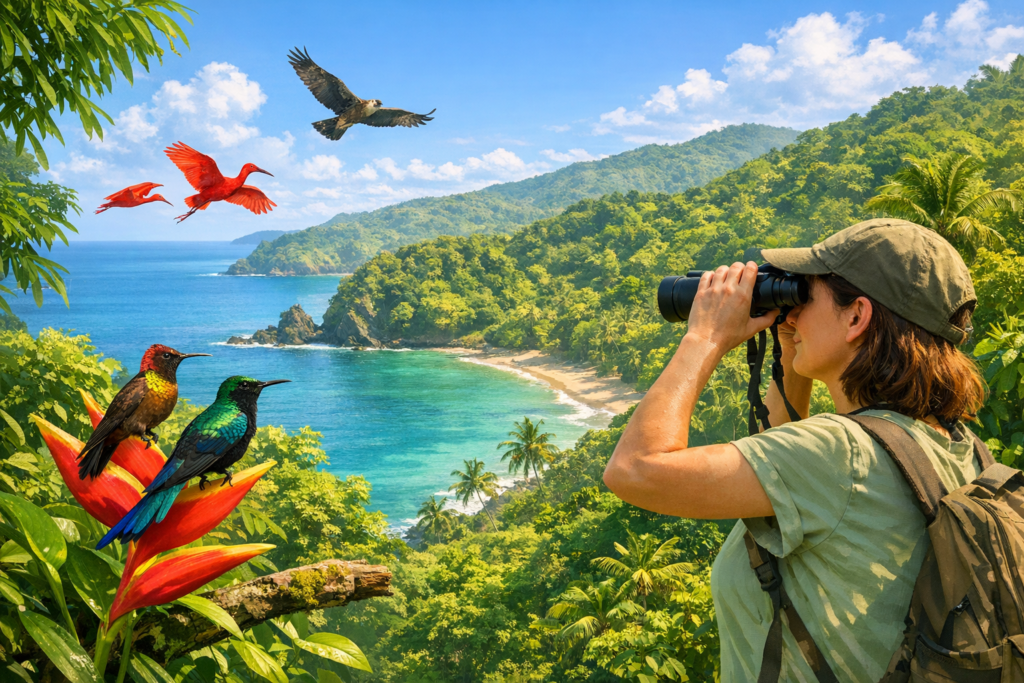
If you’re looking for a bird-watching experience that feels both exotic and surprisingly accessible, Tobago is a standout choice. Its offshore setting and drier conditions shape a bird community with some species you won’t reliably see on nearby Trinidad—so the day-to-day experience can feel fresh, even for returning visitors.
The best part is that Tobago supports birding in a practical way: ecotourism is well-established, local guides know where to look, and migration can add extra layers to what you see throughout the year.
1. Why Tobago’s birds are different from Trinidad’s
Tobago sits as the smaller island of Trinidad and Tobago, located off the East Coast of Venezuela in the southern Caribbean. Its more marine-focused environment and coral-reef scenery help set the stage for birding that feels distinct from Trinidad. The island’s drier conditions also matter—those environmental differences help explain why the species mix isn’t identical across the two islands.
Birders often notice that Tobago offers opportunities to spot species not always seen on Trinidad. While the twin-island nation is reported to have around 467 bird species, Tobago has roughly 150 to 200 reported species. That range is large enough to feel rewarding, yet focused enough that specialty birds stand out.
Among the nesting colonies that make Tobago a draw are Red-billed Tropicbirds, Magnificent Frigatebirds, and Red-footed Boobies. Specialty birds mentioned for the island include the Caribbean Martin, White-fringed Antwren, and Pale-vented Pigeon—exactly the kind of targets that can make planning worthwhile.
2. Best species and habitats: where local knowledge pays off
One of the simplest ways to improve your results in Tobago is to lean on local expertise. Since many of the island’s birds aren’t always present or consistently seen on Trinidad, the most efficient spotting often depends on knowing the right viewpoints at the right times.
Local tours and guides are especially valuable for understanding nesting sites and for identifying species behavior. That matters not only for spotting birds, but also for interpreting what you’re seeing—whether you’re looking at a nesting colony, scanning for particular calls, or trying to work out what’s feeding nearby.
Tobago also supports year-round birding. The island’s blend of habitats—shaped by its offshore location and drier conditions—means there’s usually something to find, but it’s still a place where a good guide can help turn a slow day into a memorable one.
3. How migration can shape your trip
Migration adds an extra dimension that makes Tobago more than just “steady birding.” Some birding outings can be timed around North American and Caribbean migration periods, which can open up opportunities to see a wider variety of birds as they pass through or winter.
Bird species mentioned in connection with these migration windows include jacamars, cocricos, hummingbirds, peregrine falcons, white-tailed sabrewings, and ruby-topaz. When migration aligns with your visit, it can change the feel of the trip—suddenly you’re not only searching for Tobago specialties, but also watching for visitors moving through.
Because migration timing varies, the practical takeaway is to ask locally. If your goal is to maximize chances of seeing migratory species, aligning your plans with local guidance can help you choose the best windows for excursions.
4. Practical planning tips for an easy, well-paced birding trip
Planning a bird-watching excursion in Tobago often starts with local operators or with help from your accommodation. Hotels and resorts frequently coordinate guided outings, which can reduce the friction of figuring out timing, routes, and viewpoints on your own.
For safety and sightings alike, local guides are repeatedly highlighted as a key advantage. They can point you toward the best areas to scan, explain species behavior, and help you focus your time where bird activity is most likely.
If you want to build a Tobago-focused birding library, consider using A Birder’s Guide to Trinidad and Tobago by William Murphy. It’s noted as a useful reference for learning about the region’s species and local birding hotspots, which can also help you ask smarter questions before and during your guided outings.
5. What a great Tobago birding day looks like
A memorable day in Tobago often comes down to three things: choosing a guide or operator who knows where to look, respecting the island’s distinct conditions, and staying flexible enough to benefit from seasonal movement.
When you’re on the water or near habitats shaped by Tobago’s marine and coral-reef scenery, spotting the nesting species that are part of the island’s identity can feel especially rewarding. Then, if migration is active around your visit, the experience can expand quickly—new birds appear, and the day becomes more than just routine observation.
With local insight making a tangible difference, Tobago is the kind of destination where preparation supports spontaneity: you come equipped to look, and the island helps you find what you didn’t even know you were hoping to see.