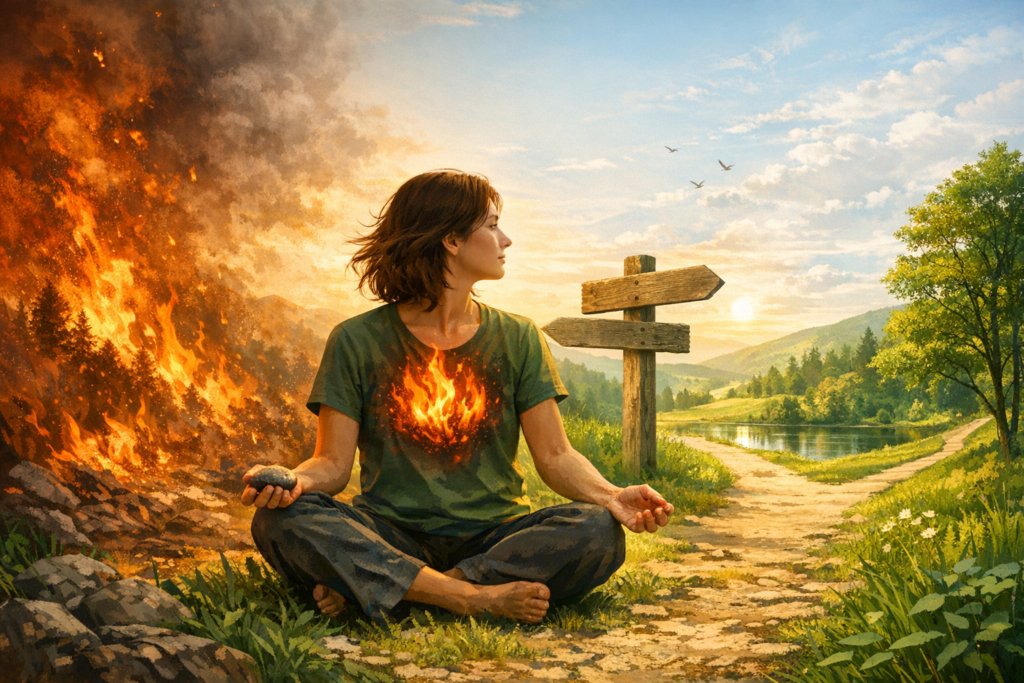
When life feels loud inside—like you’re carrying a fire that won’t go quiet—your next move matters. The search isn’t for a perfect mood or a tidy mindset. It’s for a way to respond that protects your energy, sharpens your clarity, and keeps your relationships from getting burned.
Across very different topics, a single idea keeps showing up: you can’t always control what sparks your reactions, what pressures you into conflict, or what stories get tossed into your mind. But you can control how you pause, how you yield, and what you choose to engage with. That’s where happiness and vitality get practical.
1. Passion as a life force—and a signal you can steer
Some people describe passion as a kind of fire: intense, consuming, and sometimes uncomfortable. It can feel like it gnaws at your core, pushing you toward creative work, service, community, or love. When your life connects with your roots and your soul, that inner energy rises quickly and carries you to the next level—of learning, of devotion, of growth.
But passion isn’t only heat. It’s also the friction that reminds you something needs attention. Discomfort can become motivation; energy can become fuel. The trick is learning to use both without letting either take over your entire day.
It helps to remember that the fire isn’t meant to replace everything else. Long nights of work can create a tunnel effect—sleep disappears, meals get forgotten—and that intensity may feel like purpose. Yet ordinary responsibilities still matter. Balance doesn’t mean dimming your flame; it means keeping it connected to real life.
2. Pause first: release tension to regain the natural flow
Stress often makes you grip harder than you realize. You hold the metaphorical controls with clenched teeth, mistaking strain for focus. Then you pause—just long enough to notice the holding—and everything changes. In one example, an instructor compared an airplane to something built to fly; the lesson was to relax and cooperate instead of fighting the process.
A pause brings you back to the moment rather than reacting from tension. It’s not a vague idea; it’s a simple practice: let go and become aware of where you are. A deep breath can reset your mind, and a clear view of your own state and your environment helps you see yourself as part of a larger whole.
That awareness doesn’t have to be permanent to be powerful. The goal is to maintain it as long as you can, especially when you feel yourself tightening. Pause is how you create room between impulse and action.
3. Yield when conflict heats up—so hostility loses its momentum
Not every moment is meant for direct engagement. Yielding is a way to step aside from conflict with difficult or obnoxious people. Picture a path where a boulder crashes down toward someone on a walk. Stopping it once or twice is possible, but on the third encounter, a higher response appears: step aside, let it pass, and don’t waste energy forcing the outcome.
Yield is that step aside. By not engaging, you can reduce the energy that fuels a confrontation. The hostility doesn’t always disappear—but without participation, it often loses momentum.
Yield also has a deeper use: healing emotional hurts and long-standing conflicts. Instead of trying to force feelings away, you become a calm spark of awareness that observes turmoil without feeding it. Releasing the urge to control others and allowing experiences to unfold can open space for insight—and life has a capacity to renew itself when you let the natural process work.
4. Choose deliberately: stop catching the ropes that drag you down
Even when you pause and yield, life still tosses “ropes” at you from many directions. Negative remarks, relentless media pressure, and unwanted thoughts can all feel like invitations to react. Choosing is refusing to catch those ropes. It’s a decision to protect your well-being and maintain independent, free-flowing energy.
A large part of personal difficulty comes from expecting that others will stop tossing ropes. They usually don’t. The same pattern happens internally: guilt, anger, and worry can arrive like thought ropes, tempting you to wrestle with them instead of releasing them.
Consider the mental script that “you’ll never make it” or “you’re too old to change.” Choosing means you can acknowledge that thought and then dismiss it rather than acting on it. You reclaim mental space and calm—not by denying feelings, but by deciding which ones earn your attention.
5. Use the three powers together—passion with restraint, and response with control
Pause, yield, and choose aren’t competing ideas. They’re three powers used at different times. Pause when you need clarity and want to interrupt tension. Yield when harmony requires stepping out of a power struggle. Choose when reacting to external pressure—or internal noise—would steal your energy.
When your passion feels fierce, it’s easy to fear it will consume everything else. These tools offer a different approach: keep the fire, but manage the fuel path. Pause keeps you from gripping too tightly. Yield keeps conflicts from hijacking your attention. Choose prevents you from catching ropes that aren’t yours.
And if you ever wonder where the fire came from, return to a simpler memory: the first love feeling, the time when nothing else mattered and you’d go to great lengths for that inner heat. That energy may not last forever in the same form, but it can remind you of what to look for now—your passion, showing up in unexpected ways, asking to be guided rather than endured.